

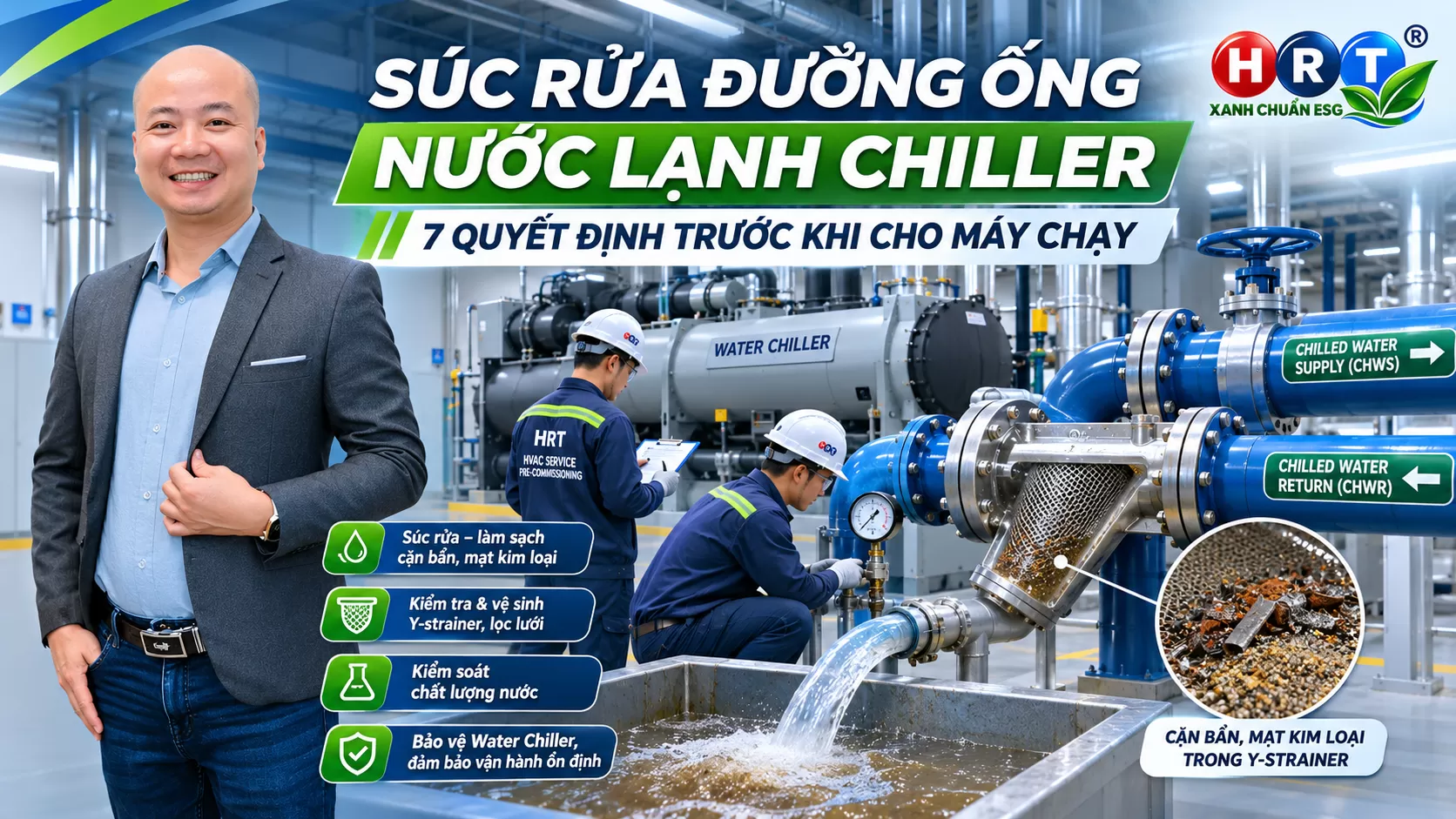
Flushing Chiller Cold Water Pipes: 7 Decisions Before Running the Machine
A Water Chiller system has just completed installation at the factory. The cold water pipes have been pressure tested, the pump has been connected, and the chiller is ready for the test run.
However, when examining the Y Strainer filter, the technical team discovered metal filings, welding slag and a significant amount of dirt.
If the system is operated immediately, these impurities can enter the Chiller evaporator, AHU coil, FCU and other devices with high requirements for water quality.
This is a hypothetical situation but reflects a real risk during HVAC construction.
From the perspective of HRT operations, I do not accept the acceptance of the cleaning of Chiller cold water pipes based solely on the following comments:
“The water is clear now, you can run the machine.”
I ask the technical team to clearly answer three issues:
-
Have all the pipes that need to be cleaned been thoroughly rinsed?
-
Are Chiller evaporators and sensitive equipment protected during the rinsing process?
-
Are there any test results that prove the water quality and system condition are eligible to move to trial operation?
Because a pipe that looks clean does not necessarily meet technical requirements.
A pump system running stably does not mean that all branches have been cleaned.
CEO Doan Van Hoang's perspective | HRT: Do not put the Chiller into operation without controlling the pipe condition, water quality and risks that may affect the equipment.
1. Why is cleaning Chiller pipes a task that must be controlled from the beginning?
Chiller cold water systems usually include the following main components:
-
Chilled Water Supply (CHWS – Chilled Water Supply).
-
Chilled Water Return (CHWR – Chilled Water Return) pipe.
-
Cold water circulation pump.
-
Evaporator or heat exchanger on the water side of the Chiller.
-
Coil AHU and FCU.
-
Control valves, balancing valves and accessories.
-
Filters, expansion tanks and related equipment.
During construction, pipe cutting, welding, mechanical processing and installation of accessories can leave behind many types of impurities.
If they are not removed before operation, risks can appear at many locations.
| Influence area | Technical risks |
|---|---|
| Medical Strainer | Clogged filter, increased pressure differential, reduced flow |
| Chiller evaporator | Obstructs water flow and affects heat exchange |
| Pump cold water | Increased risk of wear and unfavorable operation |
| Control valve | Jamming or incorrect adjustment |
| Coil AHU/FCU | Blockage, reduced heat exchange ability |
| Distribution pipe network | Hydraulic imbalance between branches |
From a management perspective, the problem is not just the cost of cleaning pipes.
What is more worrying is the cost of stopping the system, repairing equipment and the effects on production activities after handover.
Therefore, rinsing is not considered an additional task after completion of installation.
This is an important quality control point before the Chiller system is allowed to enter the commissioning phase.
2. Decision 1: Finalize the rinsing range before allowing pump operation
I do not agree with the option of just supplying water to the system, turning on the circulation pump and assuming that all pipe sections will be cleaned equally.
In a complex pipe network, water flow tends to distribute according to the resistance of each branch.
If left unchecked, low-resistance branches can receive the majority of the flow, while unfavorable branches are not flushed effectively.
2.1. The correct scope must be determined
The technical team needs to check:
-
Schematic diagram of CHWS and CHWR.
-
Main pipeline and branches.
-
Isolation valve positions.
-
Water supply, water discharge and air discharge points.
-
Areas where residue is likely to accumulate.
-
Pipe sections have just been repaired or replaced.
-
Devices that need to be isolated or bypassed.
2.2. Segmentation to control water flow
For example, a building with three floors uses AHU, FCU and a common cold water piping system.
Instead of simply rinsing the entire pipe network in an uncontrolled mode, the technical team needs to create a suitable circulation plan for each segment.
The goal is to confirm that water flow actually passes through the sections to be cleaned, not just follows the shortest route.
HRT decision
Before starting the pump, there must be:
-
Approved segmentation diagram.
-
List of valves and required operating status.
-
Water supply, circulation, discharge and collection plans.
-
The person responsible for testing each segment.
Without a clear flow diagram, there are not enough conditions to deploy rinsing.
3. Decision 2: Protect the Chiller evaporator before treating dirt
This is where I specifically ask for control.
The evaporator is an important part in the chiller's heat exchange process.
If rinsing water containing large amounts of residue passes through the heat exchanger without proper protection, pipe cleaning can create additional risks to the equipment.
3.1. Identify the device that needs to be isolated
Depending on system configuration, consideration should be given to:
-
Chiller evaporator.
-
Intermediate heat exchangers.
-
Coil AHU and FCU.
-
Sensitive control valve.
-
Meters and measuring equipment require protection.
-
The ingredients are not suitable for the intended rinsing regimen.
3.2. Set up temporary bypass
The bypass line serves to create an alternative circulation route so that water carrying impurities does not have to pass through the equipment that needs protection.
Before use, confirm:
-
The bypass line is correct according to the approved diagram.
-
The connection is tight enough and can withstand working conditions.
-
Proper flow direction.
-
Valve status has been checked.
-
There is no risk of dirty water passing through the isolated device.
It is necessary to distinguish between temporary bypass lines for cleaning purposes and long-term bypass lines in the Chiller system.
These two functions are not automatically interchangeable.
3.3. Safety control
Before disassembling or changing the circulation route, measures must be taken to isolate, reduce pressure, check safety status and control energy according to the approved plan.
HRT decision
Do not allow cleaning water containing many impurities to enter the evaporator or sensitive equipment without appropriate protection.
4. Decision 3: Choose a pump according to hydraulic conditions, not just capacity
One mistake in flushing is to assume that if you use a high-capacity pump, the pipeline will be clean.
I want the technical team to calculate based on the actual conditions of the circulatory route.
4.1. Flow and velocity are directly related
For pipes with a defined flow cross-section:
Q = 3,600 × A × v
In which:
-
Q: water flow, m³/h.
-
A: effective flow cross-section, m².
-
v: average speed, m/s.
The flow needs to have suitable conditions to carry loose impurities to the collection point or filter.
However, the flow rate and rinsing velocity must be selected according to the material, configuration and limitations of the system.
Do not default to one speed for every project.
4.2. Pressure loss must be calculated
The technical team needs to evaluate:
-
Length and diameter of each line.
-
Losses due to elbows, elbows and accessories.
-
Temporary filter resistance.
-
Status of valves.
-
Pump characteristics.
-
Pressure limits of pipes and equipment.
4.3. Check pump suction condition
Before running, make sure:
-
Sufficient water source.
-
The suction line is properly supplied with water.
-
There is no air left that could be detrimental to the pump.
-
The necessary valves are in the correct state.
-
No leaks or unusual conditions were detected.
HRT decision
Require the technical team to present the expected working point of the pump and the plan to control the flow of each segment.
Effective rinsing is not about pumping as hard as possible. Must create suitable flow conditions while still protecting system safety.
5. Decision 4: Control dirt continuously, don't wait until the end to clean the filter
During the rinsing process, impurities carried by the water flow can collect in the temporary filter or Y Strainer.
If left unchecked, residue accumulation increases resistance, reduces circulation and affects cleaning efficiency.
5.1. Parameters to monitor
-
Circulating flow.
-
Pressure at test locations.
-
Filter pressure difference when there is a suitable measuring point.
-
Amount and characteristics of residue obtained.
-
Water condition at discharge point.
-
Pump operating status.
-
Results in each segment.
5.2. Don't judge by water color alone
The water may initially be cloudy due to metal filings, sand, rust or construction materials.
After a period of circulation, the water becomes clearer but there may still be small residues, dissolved substances or adhesions that have not been removed.
Therefore, it is necessary to combine water observation with checking the amount of sediment at the filter and tests according to project requirements.
5.3. Stop in time for cleaning
When the filter accumulates significant residue or shows signs of abnormally increased resistance, cleaning must be performed according to safe procedures.
Do not continue to force the pump to work when the circulation conditions are no longer suitable.
HRT decision
Do not conclude that a segment is clean just because the rinse water is no longer cloudy. Appropriate residue test results and operating data must be available.
6. Decision 5: Do not use chemicals without proving the need
Not all Chiller cold water systems require chemical flushing.
I asked the technical team to determine in advance the type of dirt and the level of contamination.
6.1. When can rinsing with water be preferred?
For loose impurities such as construction dust, metal filings or welding slag, water circulation and flushing options can be considered in advance.
Cleaning ability depends on flow conditions and actual conditions.
6.2. When should you consider chemical cleaning?
If deposits that are difficult to remove with water are present, such as grease, rust or specific scale deposits, an appropriate cleaning method should be evaluated.
Before approving chemicals, it must be determined:
-
The nature of the dirt.
-
Pipeline materials.
-
Types of gaskets and valves.
-
Chemical compatibility.
-
Conditions of use according to the supplier's instructions.
-
Measures to protect people and equipment.
-
Wastewater collection and treatment plan.
If chemicals are used, the discharge and treatment of residues after cleaning must be verified according to the approved plan.
Three risks that cannot be ignored
Risk 1 – Material corrosion: Unsuitable chemicals can affect metal surfaces.
Risk 2 – Damage to accessories: Gaskets, valves and contact details may be affected.
Risk 3 – Chemical residue: If not treated properly, residual material can affect operating water and equipment.
HRT decision
Do not use chemicals as a default step. Only implemented when there is a technical basis and an approved plan.
7. Decision 6: Check water quality with data, not just observation
This is one of the important conditions before the system is allowed to go into operation.
I want the project team to differentiate between two requirements:
First request: Has the pipeline been cleared of debris to an acceptable level?
Second request: Does the water expected to be used in the system meet quality requirements?
These two questions are related but not interchangeable.
7.1. Check clarity and impurities
Water samples can be observed to evaluate color, turbidity and presence of suspended sediment.
However, visual observation does not fully reflect the dissolved components.
7.2. Check operating water quality
According to section 5.2.11 of TCVN 13581:2023, water used as a refrigerant in the air conditioning system needs to meet the corresponding quality criteria.
Some indicators are specified as follows:
| Target | Value according to TCVN 13581:2023 |
|---|---|
| pH at 25°C | 6.8–8.0 |
| Electrical conductivity at 25°C | Below 800 µS/cm |
| Cl⁻ ion | Below 200 mg/L |
| SO₄²⁻ ion | Below 200 mg/L |
| Alkalinity calculated as CaCO₃ | Below 100 mg/L |
| Total hardness in CaCO₃ | Below 200 mg/L |
| Iron (Fe) | Less than 1.0 mg/L |
| Silicon (SiO₂) | Below 50 mg/L |
The standard also includes other indicators, including sulfide and ammonium.
Note: These are water quality criteria used as a refrigerant, not a complete set of criteria for acceptance of rinsing work.
If the system uses a water treatment program or has specific requirements from the chiller manufacturer, all relevant requirements must be collated and their application clarified before approving the operating water.
7.3. Sampling must be traceable
Each result should show:
-
Sampling location.
-
Sampling time.
-
System status at the time of sampling.
-
Inspection criteria.
-
Method or unit of analysis.
-
Value of results and evaluation criteria.
Do not use a water sample of unknown origin to draw conclusions about the entire system.
HRT decision
Water that looks clear is a sign of observation. Acceptable quality must be based on test results consistent with specifications.
8. Decision 7: If there is not enough evidence, the Chiller cannot be started
To me, finishing rinsing and commissioning the Chiller are two different milestones.
A system may have completed its cleaning job but there are still things that need to be checked before putting the equipment into operation.
8.1. Restore correct pipeline configuration
After rinsing, the technical team needs to:
-
Remove or handle temporary connections according to the plan.
-
Reconnect isolated devices.
-
Confirm valve status.
-
Check bypass routes.
-
Clean and reinstall the filter.
-
Water supply operates as required.
-
Exhaust air and check for leaks.
-
Check circulation conditions before test run.
8.2. Check Chiller protection
Prior to start-up, relevant conditions must be confirmed according to the manufacturer's instructions, including water system status, required flow rate, and protection and interlock devices.
Rinsing results should not be considered a substitute for commissioning.
8.3. Complete technical documents
Minutes required:
-
Rinsing range.
-
Segment diagram.
-
Equipment protection plan.
-
Circulation parameters.
-
Sediment and filter test results.
-
Water quality test results.
-
Problems and solutions.
-
Confirm system configuration restore.
-
Reviewers and approvers.
HRT decision
Do not sign for acceptance just because the work has been completed in terms of volume. Only sign when there is complete evidence that meets technical requirements.
9. Three ports control HRT when rinsing the Chiller cold water system
To avoid unclear responsibilities between the construction team, the supervision department and the testing unit, I requested the deployment of three control gates.
Port 1 – Before rinsing
Confirm the scope, segmentation diagram, bypass, equipment to be protected, water supply and discharge plans, pumps and safety conditions.
Output: Approved rinsing method.
Port 2 – Before finishing cleaning
Check the results of each segment, filter condition, dirt, water quality and chemical residue if used.
Output: Records demonstrate that cleaning requirements have been met.
Port 3 – Before allowing Chiller to test run
Confirm pipeline recovery, valve status, filtration, air release, tightness and circulation conditions.
Output: Minutes confirming eligibility to move to the trial run step.
HRT principle: If you don't pass the test, you can't move on.
10. Five warning signs your cold water system may not be adequately cleaned
1. Y Strainer quickly accumulates a lot of residue
It is necessary to consider pipe sections that are dirty or have an ongoing source of residue generation.
2. Circulation flow does not meet expectations
The cause may be related to blockages, filters, valve status, air in the pipeline or pump operating conditions.
Don't assume the cause is just dirt.
3. The pressure difference across the filter increases abnormally
The amount of residue and filter status should be checked according to the operating instructions.
4. Water samples continue to show many impurities
The effectiveness of rinsing at the segments and sources of contamination should be considered.
5. Water quality does not meet requirements
The failure criteria, causes and treatment plans must be determined before approving the operating water.
I don't want the project team to increase pumping speed every time they see low flow. Must determine the cause before adjusting.
11. Checklist HRT before accepting and rinsing the Chiller pipeline
Before signing the confirmation of completion, the person in charge needs to check:
-
Fully defined CHWS and CHWR pipeline scopes.
-
Have an approved segmentation diagram and rinsing plan.
-
Confirmed status of isolation valves.
-
Chiller evaporator and sensitive equipment are properly protected.
-
The temporary bypass line is checked for safety.
-
Pump and hydraulic conditions are suitable.
-
Checked water supply, air discharge and leaks.
-
There are flow and pressure monitoring results.
-
The filter has been inspected and cleaned.
-
The segments were evaluated for fouling.
-
If chemicals are used, check treatment plans and residues.
-
Have water quality test results as required.
-
Temporary connections have been resolved and system configuration restored.
-
There are minutes, photos and test records.
-
Necessary conditions have been confirmed before moving on to test the Chiller.
This checklist is a tool to support quality control. Final acceptance must be based on project documents, applicable standards and manufacturer instructions.
12. When should you evaluate re-flushing of the Chiller system?
It's not just new construction that needs to be concerned about the cleanliness of its pipes.
For operating systems, reassessment is needed when:
-
There are major changes to the pipeline.
-
Just repaired or replaced many accessories.
-
The filter has an abnormal amount of sediment.
-
Circulatory flow is reduced due to suspected obstruction.
-
Water quality no longer meets requirements.
-
Shows signs of rust or contamination.
-
The system stopped for a long time and doubts arose about water quality.
However, do not automatically apply system flushing to all cases.
The actual situation must be analyzed to determine whether it is necessary to clean locally, rinse each segment or implement other water treatment solutions.
The correct decision is to treat the cause, not repeat a process without knowing what problem the system is having.
13. Frequently asked questions about rinsing Chiller cold water pipes
Is it necessary to use chemicals to clean Chiller pipes?
No default. The method should be selected according to the pipe condition, type of impurities, design requirements and material compatibility.
How long does it take to rinse the Chiller?
Time depends on length, diameter, number of segments, degree of contamination and tests to be performed. There is no fixed timeline for every project.
Once the water is clear after rinsing, can I run the chiller right away?
Not enough facilities. It is necessary to evaluate the sediment condition, operating water quality and technical conditions before starting up.
Is it necessary to isolate the evaporator before rinsing?
Evaporator protection measures must be determined according to the equipment configuration and approved rinsing plan. When water contains many impurities, do not let it pass through the device without a protection plan.
Does pipe flushing replace water flow balancing?
No. Rinsing is to clean the system, while flow balancing is to check and adjust water distribution according to design requirements. These are different jobs in the commissioning process.
Can a Chiller pump be used for rinsing?
The use of existing or temporary pumps must be evaluated according to pump characteristics, system configuration, contamination level, protection conditions and approved measures.
When will the completion of rinsing be accepted?
Once the segments within the scope of work have been tested, the cleaning results and water quality meet requirements, the system configuration is restored and acceptance records are complete.
14. Conclusion: Don't put construction risks into the Chiller evaporator
Flushing cold water pipes is not a simple job, just pumping water in, circulating it and then releasing it.
This is a technical process that needs to be controlled right from measure design to acceptance.
From an HRT operations perspective, I asked the project team to make seven decisions:
Closing the scope → Protecting equipment → Calculating correct hydraulic conditions → Controlling residue → Choosing the correct cleaning method → Verifying water quality → Acceptance before trial run.
A stable operating Chiller system must be built from the foundational conditions: clean pipes, satisfactory water, appropriate flow and protected equipment.
A task that can be controlled during the construction phase should not become the cause of problems after handover.
CEO Doan Van Hoang's perspective | HRT:
Do not accept based on feelings. Do not let the device run when conditions are lacking. Do not hand over without proof of quality.
HRT – Right from the beginning – Clear to the end – Green and sustainable.
HRT – Industrial Water Chiller and HVAC solution
HRT AIR CONDITIONING COMPANY LIMITED
Consulting – Design – Construction – Maintenance – Renovation of HVAC, Water Chiller, AHU/FCU, VRV/VRF and industrial ventilation systems.
Hotline: 0909.326.888
Email: CEO@hrt.vn
Website: https://hrt.vn/
Address: No. 4, Alley 6 Mieu Nha, Xuan Phuong, Hanoi.
HRT – Green Breath for Every Project.