

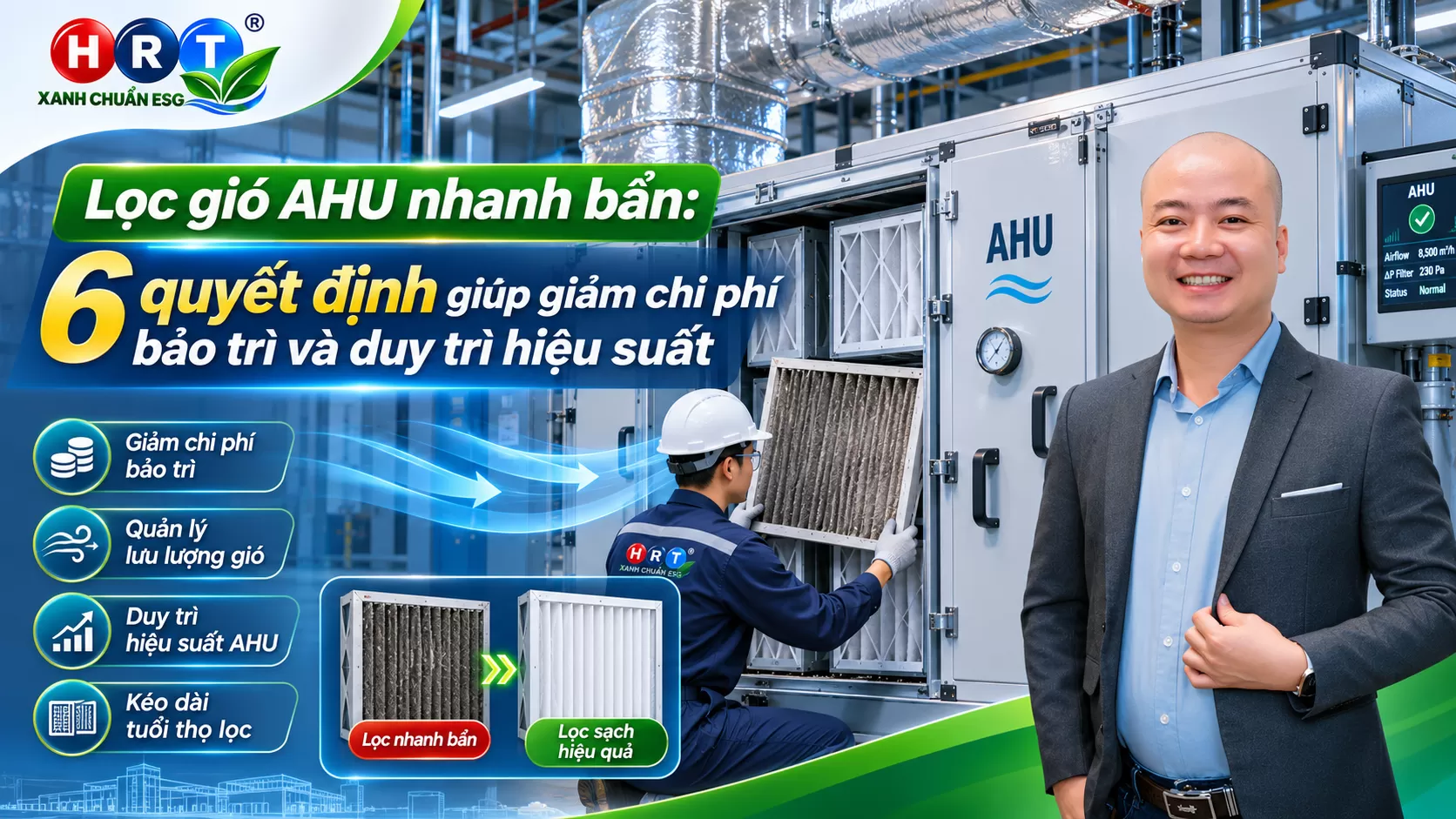
AHU air filters get dirty quickly: 6 decisions to help reduce maintenance costs and maintain performance
Author: KS. Doan Van Hoang - CEO of HRT Air Conditioning and Ventilation Company Limited
In HVAC system operation management, there is a situation I want the technical team to pay special attention to:
The AHU air filter has just been replaced but after only a short time a warning appears that it is dirty or needs to be replaced again.
If the work only stops at ordering new filters, the business may continue to incur costs without addressing the cause.
Rapidly dirty filters may be related to the air intake environment, actual dust load, filter type, system configuration, humidity conditions, or differential pressure data that have not been accurately evaluated.
For me, this is not just a matter of replacing supplies.
That is the problem of managing air quality, wind flow, electricity and total AHU maintenance costs.
At HRT, I want technicians to clearly answer three questions:
-
Why is the air filter life shorter than expected?
-
Does changing the filter solve the cause or just treat the symptoms?
-
How to determine the appropriate time to change the filter while still ensuring operating conditions?
To control this problem, I propose six important technical decisions.
1. Decide whether the filter is really dirty quickly or the system is giving an incorrect warning
When I received the notice that the AHU filter was clogged quickly, the first thing I asked for was not to buy a new filter.
I want to know what data that message is formed from.
Do not draw conclusions from differential pressure warnings alone
The pressure difference across the filter is an important index to monitor the degree of increase in air resistance.
As dust accumulates, the differential pressure usually increases if the air flow is maintained at the same level.
However, the pressure difference value depends on the actual flow rate, filter type and measurement conditions.
If the fan speed or flow rate changes, the measurement results may also change even though the filter condition remains almost constant.
Therefore, one should not conclude that the filter is dirty quickly just because the pressure difference increases at one time.
Check the reliability of the data
I propose to note:
| Category | Evaluation content |
|---|---|
| Pressure difference across filter | Actual value measured in Pa |
| Air flow | Flow conditions when measuring |
| AHU fan | Speed, VFD frequency and control mode |
| Differential pressure sensor | Signal condition and reliability |
| Pressure pipe | Blockage, leak or incorrect connection |
| BMS | Alarm thresholds and data history |
| Actual filter | Dusty, torn, deformed or damp condition |
If the sensor gives results inconsistent with the independent measuring device, it is necessary to check the measuring system before making a decision to change the filter.
Distinguish initial differential pressure and filter change limits
Each type of filter has resistance parameters at specific flow conditions.
Two commonly used values are:
Initial Pressure Drop: Initial pressure difference of new filter.
Final Pressure Drop: The final differential pressure limit is specified for the filter or system.
Filter change limits must be determined according to manufacturer documents and design documents.
Do not apply the same Pa threshold to all AHU filter levels.
In addition, if the filter is torn, contaminated with moisture or damaged and affects its function, treatment must be considered immediately, even if the pressure difference has not yet reached the replacement threshold.
Decisions to finalize: Is the filter really due for replacement, or are measurement data, alarms, or operating conditions creating a false positive?
Output: The report confirms the filter status and the reliability of the operating parameters.
2. Decide to find the source of dust that causes the filter to get dirty quickly
When the new filter continuously collects dust in a short period of time, I want the technical team to expand the inspection outside the filter compartment.
Because the filter is where the dust is trapped, but not necessarily where the problem arises.
Assess the environment for fresh air
For AHUs with the function of handling fresh air, the location of the air intake can significantly affect the amount of dust entering the system.
Need to survey:
-
Location of air intake relative to traffic road.
-
Construction activities near the site.
-
Dust source from production area.
-
Locally generated sources of exhaust gas or dust.
-
Wind conditions, weather and seasonal changes.
-
Condition of screens, air intake boxes and fresh air doors.
If the actual dust source is higher than the design assumption, the filter usage time may be shorter than expected.
Check the air return area
Not only fresh wind, return air from the area of use can also carry dust.
For example, an office area converted into a space with many dust-generating activities may create different dust loading conditions than before.
Similarly, interior construction work, drilling and cutting or changing functions can increase dust levels for a period of time.
Evaluate the cause of local dirty filters
If part of the filter surface accumulates an unusually large amount of dust, consider:
Air distribution through the filter surface: Air may be unevenly distributed due to filter chamber structure or air flow conditions.
Filter layout: Some locations may be subject to greater air loads than others.
Air leakage point: Gaps in the frame, door or related locations can cause the air flow to go the wrong way.
Do not assume that all filters have the same dust accumulation rate.
Control dust sources instead of just increasing filter changes
From a management perspective, if abnormal dust sources can be handled appropriately, businesses have a basis for improving operating conditions.
However, do not arbitrarily reduce fresh air flow to limit dust without assessing ventilation requirements and air quality.
Decisions to finalize: Is the unusual dust source coming from the outside environment, the area of use or the air distribution configuration?
Output: Report dust sources, affected areas and appropriate control solutions.
3. Decide to check the cause of AHU filter moisture and quality deterioration
A filter that fails quickly is not always due to dust accumulation.
In some cases, water or unusual humidity can cause the filter material to degrade.
This is a group of causes that need to be examined separately.
Locations where moisture may arise
For AHU systems, it is necessary to check:
Outdoor air intake: Is there any phenomenon of rainwater being swept into or seeping through the wind intake structure?
Air handling compartment: Is there standing water, leaks or signs of unusual moisture?
Heat exchanger: Is there a phenomenon of condensate being carried away by the air flow or problems related to the water tray?
Condensate drainage line: Are there blockages or improper drainage conditions?
Visitor door and AHU housing: Are there gaps, damaged gaskets or unusual condensation?
The location of the moisture source must be evaluated according to the actual configuration, as not every AHU has the same filter and coil arrangement.
Do not put a new filter in until the moisture source has been controlled
If the filter is wet due to an unresolved cause, replacing it with a new filter may only temporarily resolve the condition.
I asked the technical team to confirm the condition of the filter compartment and the source of moisture before handing over.
Do not arbitrarily dry, wash or reuse disposable filters unless the manufacturer allows it.
For filters showing signs of mold or special contamination, removal, packaging and disposal must comply with project safety requirements.
Decisions to finalize: Is the filter quickly damaged due to dust or water, humidity and environmental conditions?
Output: Minutes identifying moisture sources, remediation plans and confirming new filter installation conditions.
4. Decide on the filter configuration appropriate to the dust load and AHU fan capacity
Using a filter with a higher performance level does not necessarily mean the system will perform better in all cases.
I want to decide on filter selection based on air quality requirements and actual operating capabilities.
Filtration performance and resistance must be evaluated simultaneously
When choosing a filter, parameters to consider include:
| Parameters | Meaning in choice |
|---|---|
| Level of filtration performance | Ability to hold particle groups to applicable standards |
| Rated flow | Published traffic conditions |
| Initial pressure difference | Resistance of new filter at specified conditions |
| End differential pressure limit | Basis for determining use limits |
| Size, depth | Mounting bracket compatibility |
| Material structure | Conditions of use and maintenance |
| Frame, gasket, holding mechanism | Sealed and stable mounting ability |
For general ventilation filtration, reference can be made to the ISO 16890 series of standards for classifying performance according to dust particle groups.
However, filter level, size and differential pressure parameters must be considered along with the operating conditions of the AHU.
Don't just rely on trade names or external dimensions.
Evaluate the role of primary filtration and fine filtration
Many AHUs use multi-level filtration systems to meet air requirements.
In the right configuration, the primary filter traps a large portion of the dust before the air passes through to the next level of filtration.
If the primary filter is removed or replaced with an unsuitable type, the dust load affecting the following filter levels may change.
But adding a filter level also creates resistance and requires installation space.
Therefore, you should not arbitrarily add or change the order of filter levels without evaluating the design, fan capacity and related conditions.
Check the Filter Bypass phenomenon
A filter with good performance does not mean the filter assembly is working well if air can bypass the filter material.
Locations to evaluate:
-
Gap between filter and frame.
-
The gasket is no longer suitable.
-
The retaining pin or slide rail is damaged.
-
Deformed filter frame.
-
Gap between filter modules.
A filter with an unusually low differential pressure should also be carefully evaluated, as such data is not sufficient to demonstrate good filtration efficiency.
Decisions to finalize: Is the current filter type and configuration suitable for the required air quality, dust load and AHU capacity?
Output: List of approved filtration materials and appropriate filtration configuration options.
5. Decide to schedule filter changes based on status instead of just a fixed schedule
In operations management, I don't want businesses to just use a simple rule:
"Change every three months."
A regular inspection schedule is necessary, but filter change timing must be tied to actual usage conditions and technical limitations.
Set up filter life monitoring data
For each AHU, a minimum of:
-
AHU code and location.
-
Model, type, filter level.
-
Date of last filter change.
-
Initial pressure difference after replacement.
-
Pressure difference during tests.
-
Air flow or fan mode at the time of measurement.
-
Total operating hours if data is available.
-
Actual condition of the filter.
-
Limit filter changes according to applicable profile.
Watch for changing trends
Hypothetical illustrative example:
| Check times | Measured pressure difference | Conditions |
|---|---|---|
| After replacing the filter | 80 Pa | Reference flow |
| 2nd time | 105 Pa | Equivalent flow |
| 3rd time | 135 Pa | Equivalent flow |
| 4th time | 170 Pa | Equivalent flow |
This data series only illustrates the trend of increasing differential pressure over time, not the standard filter change threshold.
If the technical document specifies the end limit as a specific value, the manager needs to compare the actual measurement results with that value.
If the rate of differential pressure increase is suddenly different from history, it is necessary to find the cause before deciding to just replace the filter.
Leverage BMS data
With AHUs with integrated BMS, differential pressure history, fan status, operating times and alarms can be used to support maintenance planning.
However, managers must confirm sensor reliability and device status before using the data.
Do not adjust the warning threshold arbitrarily to prolong filter usage time.
Develop decision principles
I propose to distinguish:
Normal state: Suitable parameters, filter shows no signs of damage; Continue monitoring as planned.
Status to check: Abnormal differential pressure trends, increased dust load, or inconsistent data; perform diagnosis.
Status to be handled: Reach replacement limit or detect damage affecting function; Implement appropriate replacement or repair plans.
Specific limits and conditions must be approved system by system.
Decisions to finalize: When to continue operation, when to increase inspection and when to change filters?
Output: AHU filter maintenance plan by condition, with data and decision thresholds.
6. Decide to control total maintenance costs instead of just comparing filter prices
A filter with a low purchase price is not necessarily the most economical option.
If the filter material does not meet the requirements, deteriorates quickly or causes inadequate resistance, operating and maintenance costs may increase.
On the contrary, a higher price filter is not necessarily beneficial if it is not suitable for the system configuration.
Total costs need to be considered
I would recommend supplies rated on the components:
Material costs: Price of filters, gaskets and accessories.
Labor costs: Disassemble, clean, test and accept.
Downtime costs: The time the AHU is inactive and affects the area of use.
Cost of old filter treatment: Collect, package and process as required.
Operating costs: Fan power and other influences within measurable range.
Cost of risk: Impact on air quality, equipment or production requirements if improper filtration is used.
No commitment to saving electricity just from changing filters
Reducing the differential pressure through the filter can change the working conditions of the fan.
With AHUs using inverters to maintain flow, reducing resistance can facilitate reducing fan speed in some cases.
With a fixed speed fan system, flow rate and power capacity can vary according to fan and system characteristics.
Therefore, you should not assume that replacing a new filter will save a fixed percentage of electricity.
If energy efficiency is to be evaluated, comparable power, flow rate, and operating condition data must be available.
Control the quality of purchasing materials
I recommend that the purchasing and engineering departments jointly confirm:
-
Appropriate material code and filter level.
-
Size and compatibility.
-
Product technical documents.
-
Pressure differential and published flow.
-
Transportation and storage requirements.
-
Quality records need to be handed over.
-
Planned backup quantity.
Do not approve materials just because the unit price is low or the size is similar to the filter in use.
Decisions to finalize: Which filtration option meets technical requirements and has a reasonable total cost of use?
Output: List of supplies and life cycle cost plan for AHU filter maintenance.
7. Quick diagnostic matrix for AHU air filter dirty quickly
For targeted processing, I recommend the following control table:
| Phenomenon | Prioritize testing | Decision direction |
|---|---|---|
| Filter quickly collects dust after replacement | Dust source, fresh air load, usage conditions | Trace the dust source and evaluate the actual load |
| Pressure differential increased abnormally | Flow rate, pressure point, sensor | Confirm data before replacing |
| The filter gets wet quickly | Water source, condensation, drainage line | Treat moisture sources and damaged filters |
| New filter has too high differential pressure | Type, flow, configuration | Compare filter parameters and design |
| Dust gets through later | Gaskets, filter rack, gaps | Restore filter assembly tightness |
| Filter must be changed regularly | Dust load history, run time, replacement criteria | Review maintenance program |
The table above should not be considered a final diagnosis. Field confirmation data is required.
8. Three AHU air filter maintenance management ports according to HRT
From an operational perspective, I recommend using three control ports throughout.
Gate 1 – Confirm the correct cause
Evaluate filter condition, dust load, humidity and differential pressure data.
Output: Technical conclusions and treatment plans.
Gate 2 – Approve materials and maintenance plans
Confirm filter type, replacement scope, safety conditions, shutdown schedule and cost.
Output: Material requests and approved work plans.
Gate 3 – Verify results and hand over
After replacing the filter, it is necessary to confirm the tightness of the filter assembly, differential pressure, flow rate, fan status and related warnings.
Output: Acceptance minutes, operating data and follow-up inspection schedule.
HRT principle: Unknown cause - do not rush to change. Incorrect materials – not approved. No data – no conclusion.
9. Frequently asked questions about AHU air filters dirty quickly
9.1. Why does the newly replaced AHU air filter clog so quickly?
It may be due to high actual dust load, unusual dust source, inappropriate filter configuration, different operating flow than design or inaccurate differential pressure data. Need to check to determine the specific cause.
9.2. Should the AHU filter be changed every three months?
There is no fixed period that applies universally. The inspection schedule and filter change time should be consistent with the manufacturer, environmental conditions, operating time and actual condition.
9.3. New filter but high differential pressure, does it mean poor quality filter?
Cannot conclude yet. It is necessary to check the filter type, flow rate, measurement location, sensor status and published technical specifications.
9.4. Should I upgrade the AHU air filter to a higher performance level?
Can be considered when the system has adequate air quality requirements and the fan is capable of meeting the additional resistance. Do not arbitrarily upgrade based on the filter level.
9.5. Does changing the AHU filter help save electricity?
Possible under some operating conditions. The amount of power change depends on fan characteristics, control and flow. Need to test before drawing conclusions.
9.6. Can the AHU filter be dried and then used again?
Do not arbitrarily reuse if the manufacturer does not allow it. It is necessary to evaluate the condition of materials and the cause of moisture, and comply with construction safety procedures.
9.7. Does AHU using HEPA filtration apply this management method?
Principles on data, causes and responsibilities are available for reference. However, specific HEPA, cleanroom, medical or manufacturing systems need to comply with unique performance testing, replacement and validation requirements.
10. HRT – Manage AHU maintenance with data and accountability
In the HVAC industry, I don't judge the quality of work solely by the number of filters changed or the number of maintenance completed.
What I need is proper operations, controlled air quality and affordable maintenance costs.
At HRT, we aim for three core values:
GET IT RIGHT
Evaluate the filter status, causes and operating conditions before making a plan.
CLEARLY
Each job must have a specific scope, inspection criteria, specifications, and responsibilities.
DEDICATED
Monitor results, support operations departments to maintain efficiency and limit recurring damage.
HRT provides HVAC general contractor solutions, including:
-
Design, construction and renovation of AHU/FCU.
-
Check and maintain the air filtration system.
-
Clean the AHU heat exchanger.
-
Measure system flow and pressure.
-
Maintain Water Chiller and VRV/VRF.
-
Consulting on management and optimization of HVAC operations.
For projects that are experiencing AHU filters becoming dirty quickly or frequently incurring replacement costs, preparing equipment records, filter change history and differential pressure data will help make the survey process more grounded.
11. Conclusion: Don't just change the AHU filter, control the cause of rapid filter failure
A new filter can solve the situation of supplies that have reached the end of their useful life.
But if the cause of unusual dirt, moisture or damage is not addressed, the problem may continue to recur.
From a management perspective, I want the HRT team to make six decisions:
-
Confirm correct filter status and measurement data.
-
Tracing unusual dust sources.
-
Control the cause of moisture.
-
Select the appropriate filtering configuration.
-
Develop a filter change plan according to condition.
-
Manage costs and verify results.
Do not change filters based on feeling. Don't choose materials based on price alone. Do not accept without proof.
That's how HRT looks to manage AHU maintenance in commercial and industrial buildings.
KS. Doan Van Hoang – CEO of HRT
HRT – Green Breath for Every Project
Right from the beginning – Clear to the end – Sustainable green.
HRT contact information
Website: https://hrt.vn
Email: ceo@hrt.vn
Hotline: 0909 326 888